Ugly on Purpose: The Underground Market for Content That Refuses to Be Pretty
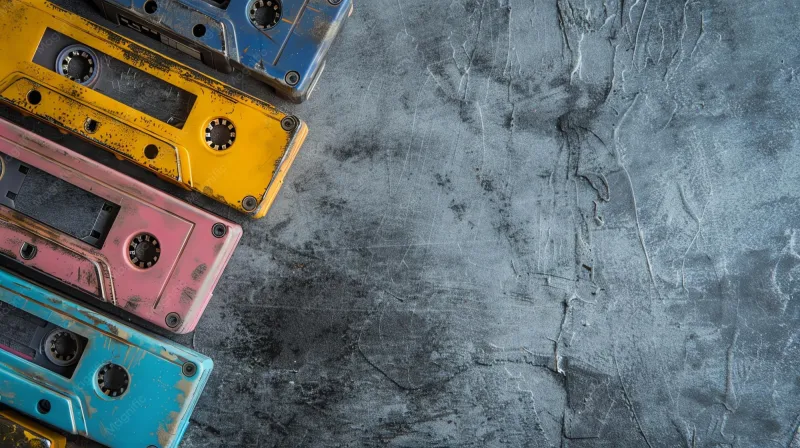
Photo: lo-fi analog cassette tape vintage texture grunge aesthetic, via img.freepik.com
At some point in the last few years, polished started to feel like a warning sign.
You know the look. The perfectly lit flat lay. The sans-serif font in exactly the right shade of warm gray. The YouTube thumbnail with the creator's mouth open in practiced surprise. The Spotify playlist cover that looks like it was designed by a committee of algorithms. Everything calibrated, A/B tested, optimized for retention.
And then something started happening on the fringes. People began paying for the opposite.
The Market for Rough
Check Patreon's discovery pages and you'll find creators whose entire value proposition is that they haven't cleaned anything up. Rambling hour-long audio essays recorded on equipment that probably cost less than a dinner out. Zine-style newsletters with clashing fonts and hand-drawn graphics that scan at weird angles. Music that sounds like it was recorded in a bathroom — because it was.
These aren't failed attempts at production quality. They're deliberate rejections of it. And people are subscribing, paying, and coming back.
A musician operating out of Philadelphia under a name that looks like a keyboard smash has been releasing lo-fi ambient tracks on Bandcamp for three years. No press photos. No bio beyond a single cryptic sentence. The music sounds like it's coming through a wall from another apartment. He has a few thousand paying followers and a waiting list for physical releases.
"I got an email once from someone who said my stuff was the first music in years that didn't feel like it was trying to sell them something," he said in a rare public post. "That was the whole point."
Creator Fatigue Is Real, and It's Contagious
To understand why weird is winning, you have to understand how exhausted the mainstream creator pipeline has become — not just for audiences, but for the people making things.
The optimization treadmill is brutal. Creators who chase algorithmic favor on YouTube, TikTok, or Instagram end up in a feedback loop where every decision — length, format, thumbnail design, posting frequency, even the emotional register of their voice — gets measured against performance metrics. The output starts to look less like expression and more like manufacturing.
Creators who've been in that system for years describe a specific kind of burnout that's hard to articulate. It's not exhaustion from working too hard. It's the feeling of having slowly replaced yourself with a more optimized version of yourself, and then looking in the mirror and not recognizing what you built.
The ones who break away often describe it in almost physical terms — like taking off a piece of clothing that was too tight. The weird, unoptimized stuff they make afterward isn't necessarily less work. It's just work that feels like it belongs to them again.
What Audiences Are Actually Buying
Here's the counterintuitive part: the audiences paying for rough content aren't doing it out of irony or nostalgia. They're doing it because the roughness is the signal.
In a landscape where everything has been sanded down and personalized to the point of uncanny familiarity — where your feed knows what you want before you do, where every recommendation is a calculated reflection of your own preferences — something that feels genuinely unoptimized reads as authentic in a way that nothing else can fake.
The imperfection isn't a bug. It's proof of origin. It says: a person made this, for reasons that had nothing to do with your watch time.
This is what some cultural critics are calling the "strangeness premium" — the extra value that accrues to content specifically because it resists the logic of the attention economy. It's not that audiences want bad content. It's that they've learned to read polish as a kind of manipulation, and roughness as a kind of honesty.
Lo-Fi Platforms and the Infrastructure of Weird
The infrastructure is catching up to the aesthetic. Platforms built specifically for unoptimized content are finding real audiences.
Bandcamp, for all its flaws, has become a genuine home for music that would never survive an algorithm. Itch.io has done the same for games — strange, personal, sometimes barely functional games that exist because someone wanted to make them, not because a market analysis said they should. Substack, at its best, hosts writers who are clearly thinking out loud rather than delivering a polished product.
There's also a resurgence of formats that resist optimization by design. Newsletters with no images. Podcasts with no editing. Websites that look like they were built in 2003 — not because the creator doesn't know any better, but because the aesthetic communicates something specific: we're not here to impress you, we're here to say something.
The Utrang sensibility knows this territory. Strange signals from the digital fringe don't come wrapped in clean packaging. They come through static.
Beautifully Broken as a Communication Strategy
There's a deeper argument lurking in all of this, one that goes beyond aesthetics into something more fundamental about how we communicate online.
The tools for faking authenticity have gotten very good. AI can generate content that sounds personal. Production tools are cheap enough that anyone can achieve a professional sheen. In that environment, the only way to signal genuine human origin might be to show the seams — to let the weird in, to leave the rough edges, to resist the compulsion to optimize.
"Beautifully broken" isn't just a look. It might be the only honest grammar left for online communication. When everything can be polished, only the unpolished tells the truth.
This is especially visible in how younger creators are approaching their work. The TikTok generation, raised on algorithmic content, is increasingly drawn to formats that feel like they escaped the algorithm — lo-fi vlogs shot on old digital cameras, text posts that look like they belong on a Tumblr circa 2011, music with audible room noise and human breath.
The nostalgia isn't really for the past. It's for a time before every creative decision was a data point.
The Limits of the Rebellion
None of this is without contradiction. The strangeness premium can be gamed. "Authentic weird" is already becoming its own aesthetic category, which means it can be reverse-engineered, manufactured, and sold by people who understand the market for it.
When weird becomes a brand strategy, it stops being weird. The rough edges become a texture applied over the same optimization logic. The lo-fi aesthetic gets licensed to a streaming service. The zine gets a corporate sponsor.
This is the trap at the center of every cultural rebellion against mainstream aesthetics: the mainstream is very good at absorbing its own opposition.
But for now, at least, there's still a real market at the edges — small enough to be genuine, strange enough to resist easy replication. People are still making things that don't want to be found by the algorithm. And other people are still going out of their way to find them.
That's not nothing. In 2025, that might actually be everything.