Collecting the Corpses: How Dead Websites Became the New Fine Art
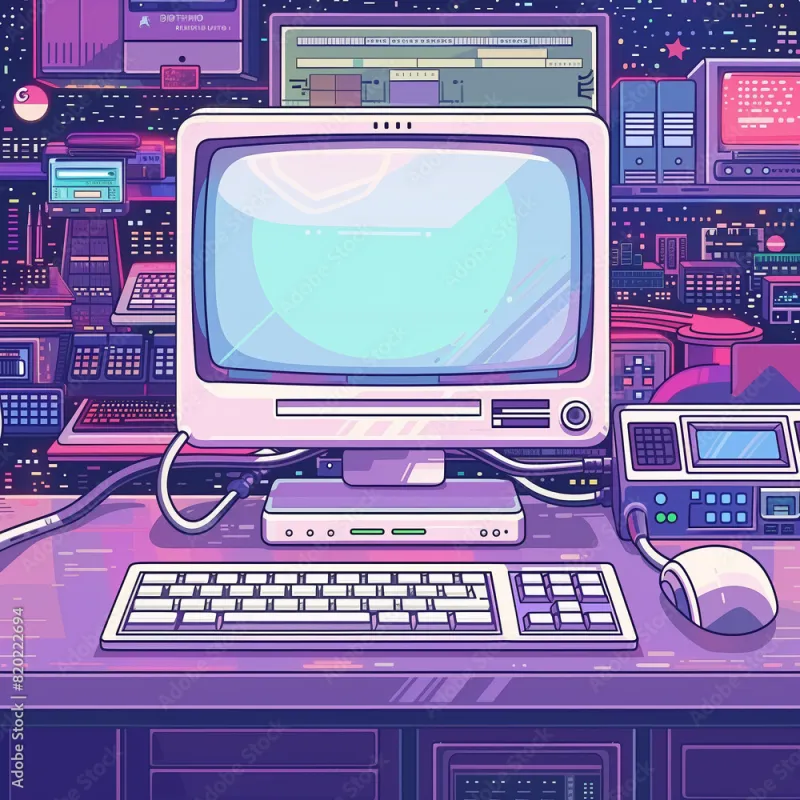
Photo: old retro computer screen website 90s aesthetic vintage digital, via as1.ftcdn.net
There's a Geocities page from 2001 that nobody has updated in over two decades. The background is a repeating tile of black flames. The guestbook is full of strangers saying "cool site!!" The hit counter stopped at 4,872. The owner probably forgot it existed around the time they got their first smartphone.
To most people, it's digital garbage. To a growing subculture of collectors, archivists, and remix artists, it's something closer to a Basquiat.
The Rubble Has a Fanbase
What's happening right now in certain corners of the internet is genuinely hard to categorize. Call it digital archaeology, call it nostalgia tourism, call it whatever you want — the core behavior is the same. People are deliberately hunting down dead or dying websites, screenshotting them obsessively, and treating the visual wreckage as raw material for something new.
The Wayback Machine, Internet Archive's sprawling snapshot database, has quietly become one of the most creatively mined resources on the internet. It's not just researchers and journalists poking around in there anymore. Gen Z designers and artists are using it like a thrift store, pulling out visual elements from defunct mid-2000s message boards and early-2000s fan pages the same way someone might rifle through a bin of vintage band tees.
The attraction isn't ironic, exactly. Or at least it's not only ironic. There's something genuinely moving about these frozen digital spaces — the way they captured a specific moment in internet culture and then got left behind, preserved in amber by sheer neglect.
Why Broken Looks Better
Here's the uncomfortable truth that corporate web design teams probably don't want to hear: a lot of people find a busted 2003 Angelfire page more visually interesting than a modern SaaS landing page.
It's not hard to understand why. Contemporary web design has converged into something almost aggressively legible. Sans-serif fonts, lots of white space, hero images with soft gradients, CTAs in rounded rectangles. It's optimized, A/B tested, and completely devoid of personality. Every major site looks like it was designed by the same committee following the same deck.
Old websites didn't have those constraints. They had one person with a copy of Microsoft FrontPage and a strong opinion about which animated GIF best represented their love of Linkin Park. The results were chaotic, often hideous, and completely sincere. That sincerity is the thing that's become rare.
When something is broken — a layout that renders wrong because the CSS references a stylesheet that no longer exists, a photo that loads as a mosaic of corrupted pixels — it carries an accidental honesty. It wasn't designed to fail gracefully. It just failed, and the failure is visible, and somehow that visibility feels more real than anything built today.
Screenshot as Medium
The collecting behavior itself is worth examining. These aren't people downloading source code or building emulators. The primary artifact is the screenshot — a flat image of a website at a specific moment in time, often captured through the Wayback Machine's imperfect rendering engine, which adds its own layer of distortion.
Creators on Tumblr and Instagram are building entire aesthetic identities around these images. Collages layered with defunct forum interfaces, early Flash game menus, and the color palettes of abandoned fan wikis. The visual language has its own name in some communities: "webcore" or "indie web aesthetic," though the labels shift constantly.
What makes this interesting is how the screenshot changes the nature of the original object. A broken website is, functionally, a failure — something that no longer works the way it was intended. A screenshot of that broken website is a deliberate artistic choice. The framing turns dysfunction into composition. The collector decides what's in the frame, what gets cropped out, what moment of digital decay is worth preserving.
That's curatorial work. That's what art collectors do.
The Authenticity Equation
There's a generational dimension here that's hard to ignore. A lot of the people most drawn to this aesthetic are too young to have actually used these websites when they were live. For them, a 2002 Geocities page isn't a memory — it's something stranger. It's evidence of a time when the internet was built by individuals who were figuring it out in public, making ugly things with enthusiasm, and putting them online without any expectation of audience metrics or brand alignment.
For a generation that grew up with the feed, the algorithm, and the constant pressure to optimize content for engagement, that casualness reads as radical. The imperfection isn't a bug. It's proof that something was made by a human who didn't care whether it performed well.
That's the authenticity equation at work. Polished equals performed. Broken equals real. It's not a logically airtight argument, but it's an emotionally coherent one, and it's driving actual creative output.
Preservation as Practice
Not everyone in this space is making collages. Some people are doing more straightforward archival work — cataloging visual design trends from specific eras, documenting the typography of early web, building databases of defunct site structures before they disappear entirely.
The Internet Archive does heroic work, but it can't catch everything, and its rendering of old pages is often incomplete. Independent archivists are filling gaps, sometimes with a level of obsessive specificity that borders on scholarly. There are people who have spent years documenting nothing but the button design conventions of early 2000s e-commerce sites.
This is Internet Archaeology in the most literal sense. Digging through layers of digital sediment to understand how a culture built its spaces, what it chose to put on the walls, how it organized itself before anyone told it there were rules.
What Gets Lost When Nothing Breaks
The broader cultural question lurking under all of this is about what a frictionless, optimized internet costs us. When every surface is smooth and every experience is tested for maximum usability, something disappears. The rough edges are where personality lives. The broken parts are where you can see the seams, and seeing the seams is how you understand how something was made.
The people collecting dead websites seem to understand this intuitively. They're not just being nostalgic. They're making an argument — through screenshots and collages and archival obsession — that the internet's most interesting period was when it was still figuring itself out. When it was still allowed to be wrong.
Maybe that argument is right. Maybe it's just aesthetics. But either way, someone out there is framing a screenshot of a broken Neopets fan page from 2004, and honestly? It kind of slaps.